Contact Us

Pudong advances embodied AI as AgiBot teams up with CUHK and SAIC-GM
Shanghai's Pudong New Area is accelerating the development of its embodied AI industry as enterprises such as AgiBot drive the technology from laboratory research into real-world applications.
AgiBot, a Shanghai-based robotics firm in Pudong, announced that it has partnered with the Chinese University of Hong Kong (CUHK) to jointly establish an embodied AI industry-academia-research collaboration platform. The two sides will focus on the development of general-purpose embodied intelligence models and the cultivation of talent.
AgiBot will leverage its industrialization capabilities and real-world application scenarios by providing dedicated R&D funding, robotic hardware platforms, high-quality data resources, and access to application environments. Meanwhile, CUHK will contribute its strength in artificial intelligence research, organizing academic teams to work alongside the company on fundamental research and technical challenges.
Both parties plan to establish a long-term mechanism for the joint training of high-level talent. In the first phase, AgiBot will open a substantial number of internship positions and research projects, enabling students and young researchers to participate in frontier topics and hands-on engineering practice.
In parallel developments, a robot has recently begun working at the Ultium super factory of SAIC General Motors (SAIC-GM). Built on AgiBot's A2-W robot, the robot has been deployed on battery production lines to perform high-precision tasks, marking one of the first applications of humanoid robots in mass production environments within the automotive industry.

A robot works on a production line. [Photo/AgiBot]
AgiBot is also working with SAIC-GM to explore the use of its bipedal humanoid robot in scenarios such as fixture plugging and other processes in new energy vehicle manufacturing. The introduction of humanoid robots is expected to further expand the boundaries of intelligent manufacturing.
 Pudong lights up city with spectacular shows and cultural marvels
 Brilliant light show to illuminate Huangpu River
 Maple leaves paint splendid scenery in Pudong
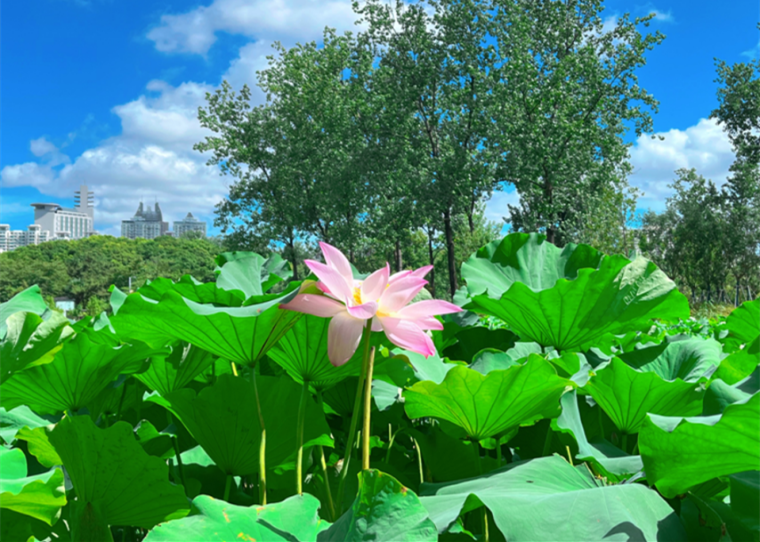 Appreciate alluring lotus blossoms in Pudong's Century Park